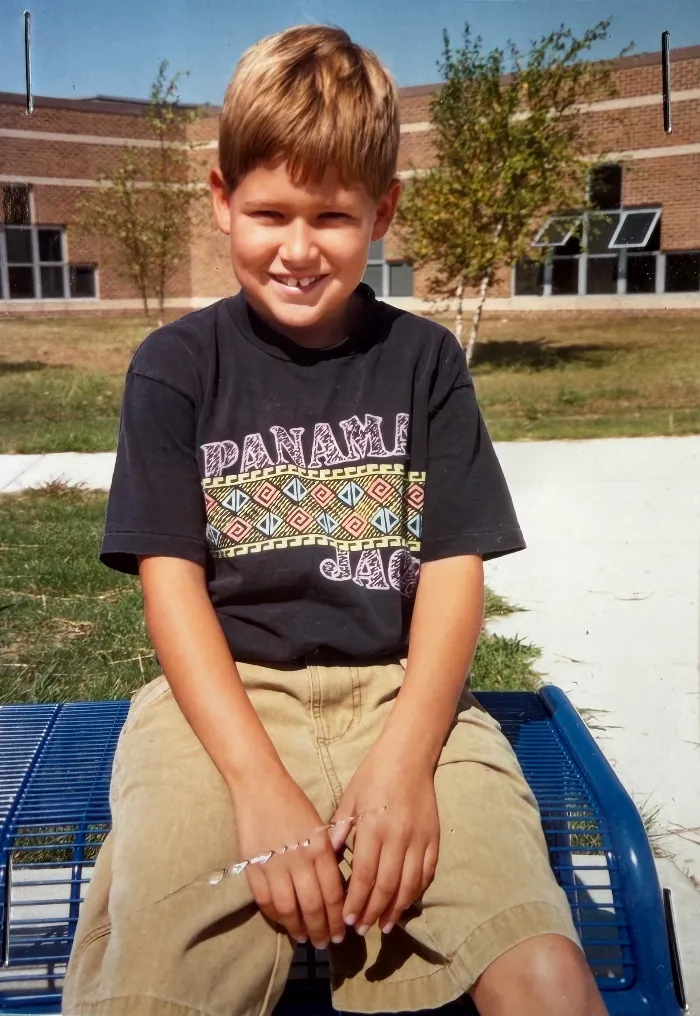
Intuition... the quiet voice that guides us all. When I was eight, mine told me I should probably be a wizard. So I went looking for real magic, and I found it where any kid would: at Spencer Gifts, somewhere between the lava lamps and the whoopee cushions. It was a tarot deck, and to me, it was proof that magic was something I could hold.
But I grew up among good Midwesterners with deeply rooted values, the kind where Sunday mornings were for church and magic was strictly off-limits. The adults around me were scared of what it might mean. Nobody explained why. It was just a hard line: we don't talk about those things. And when you're eight, a rule with no reason feels like danger.
So I did what any terrified eight-year-old would do, and hid the deck in the hall closet under a pile of blankets. Without anyone meaning to teach me, I learned where to put the parts of me that didn't fit. And I used that lesson on far more than tarot.
For years, that's where things stayed. I grew up, built a career, and made a life that looked the way it was supposed to. But the questions I'd shelved at eight never really went away. They just waited.
It wasn't until my thirties that my view of the world started to shift. I realized it was okay to ask questions, even the ones I'd been taught never to ask. And the first thing I started questioning was my own inner dialogue. I'd always assumed it was all one thing: my intuition, my gut, my instincts. But I began to notice that some of it was just fear, rules I'd absorbed so young they felt like my own. And fear wasn't the only voice in there. There was desire, dressed up as a sign. Old wounds, sounding alarms about things that were long over. The inner critic, telling me I wasn't ready. Even plain old tiredness can pass for a bad feeling. They all sounded like intuition. So I started asking: how do you tell which voice is actually yours?
As I tried those questions on for size, I went looking for how the generations before me had found their way through the same thing. And I kept coming back to the very thing fear had made me hide.
Tarot turned out to be the mirror I needed. Most people think of it as spooky cards that predict the future. But it didn't start that way. Tarot was born in fifteenth-century Italy as a card game, with painted cards showing the figures everyone recognized: the fool, the lovers, the hermit, death, the world.
Centuries later, a secret society formed in London to find how the world's ancient teachings, from astrology to alchemy, all weave together into one story. Tarot sat at the heart of it. From the outside, their robes and rituals looked sinister, and that's where the spooky reputation comes from. But underneath, they built on two ancient ideas: "know thyself," carved at the entrance to the Temple of Apollo, and "as above, so below," the belief that the patterns of the universe are reflected inside each of us.
And here's the irony that stopped me in my tracks. The deck most people picture today was designed by Arthur Edward Waite, a devout Christian mystic. The very cards I'd been taught were outside my faith were shaped by someone looking deeper into his. To Waite, tarot wasn't about predicting anything. It was a map of the soul's journey.
Look at the cards closely and you'll see it too. It's the story of a life: beginnings, love, loss, struggle, change, and coming home to yourself. So when you draw a card, you're not seeing your future. You're seeing yourself in a story people have recognized for six hundred years.
You don't need to join a secret society, hooded robes, secret handshakes and all, to know yourself. You just need a mirror.
So I took the deck back out of the closet. This time, I wasn't looking for magic. I was looking for myself.
I built Rooted to be that mirror for you, so you can learn to discover and trust your own Intuition.
Chris, founder of Rooted